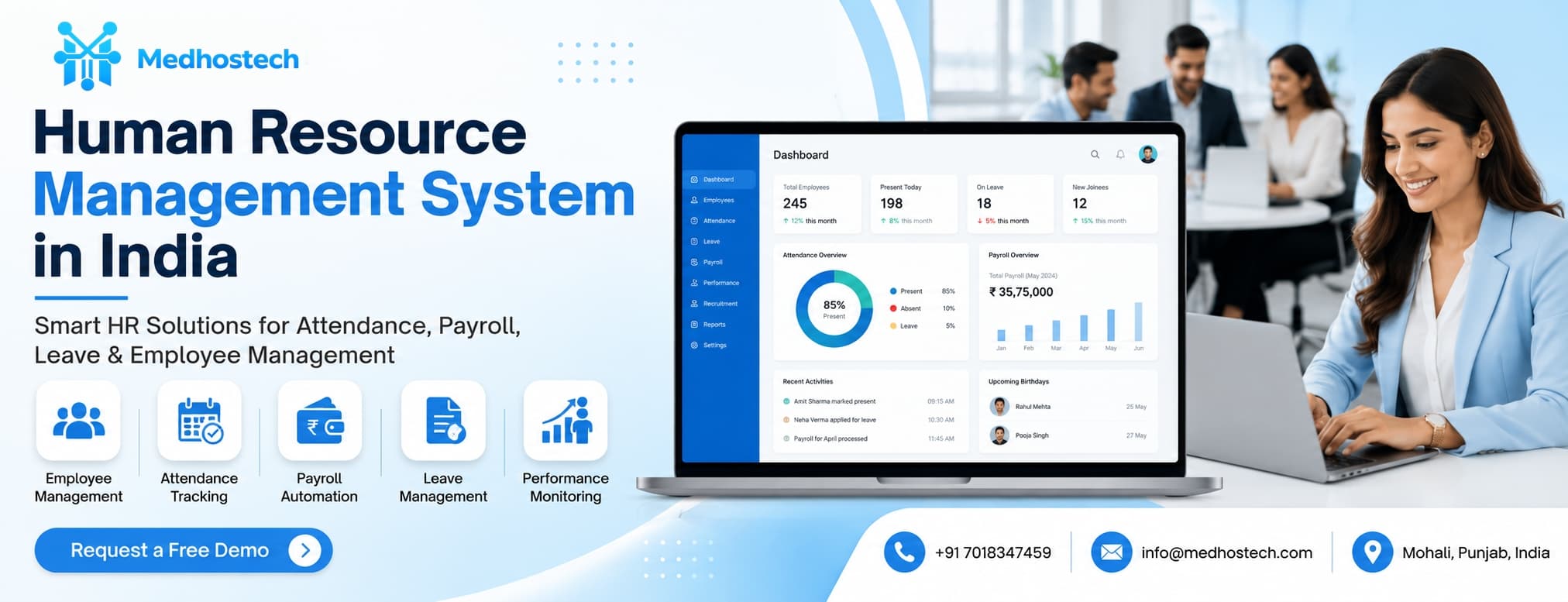
Human Resource Management System in India Medhostech offers an advanced HRMS solution designed to simplify employee management, payroll processing, attendance tracking, leave management, and performance evaluation. With a user-friendly interface and powerful automation features, businesses can reduce manual work, improve efficiency, and enhance employee satisfaction.
Medhostech Editorial
Healthcare IT & software insights
In today’s competitive business environment, managing employees efficiently is no longer an option—it is a necessity. Organizations across industries are investing in advanced digital solutions to streamline workforce operations, improve productivity, and enhance employee satisfaction. One of the most effective tools helping businesses achieve these goals is a Human Resource Management System in India.
From recruitment and onboarding to payroll processing and performance evaluation, a modern HR management system simplifies every aspect of human resource management. As Indian businesses continue embracing digital transformation, the demand for intelligent HR software solutions is growing rapidly.
What is a Human Resource Management System?
A Human Resource Management System (HRMS) is a comprehensive software solution designed to automate and manage various HR functions within an organization. It acts as a centralized platform where employers can handle employee information, attendance, payroll, leave management, recruitment, training, performance monitoring, and compliance requirements.
Instead of relying on manual paperwork and spreadsheets, organizations can use a Human Resource Management System to streamline processes, reduce administrative workload, and improve operational efficiency.
Why Businesses Need a Human Resource Management System in India
The Indian business landscape is evolving at an unprecedented pace. Companies are managing larger workforces, hybrid work environments, and increasingly complex compliance requirements. Manual HR processes often lead to errors, delays, and inefficiencies.
Here are some key reasons why businesses are adopting a Human Resource Management System in India:
Improved Efficiency
Automation eliminates repetitive HR tasks, allowing HR professionals to focus on strategic initiatives rather than administrative work.
Better Employee Experience
Employees can access their information, apply for leaves, download salary slips, and update personal details through self-service portals.
Accurate Payroll Processing
Payroll errors can impact employee trust and satisfaction. HRMS solutions automate calculations and ensure timely salary processing.
Regulatory Compliance
Indian labor laws and compliance regulations require accurate record-keeping. HR software helps organizations stay compliant and avoid penalties.
Data-Driven Decision Making
Advanced analytics and reporting tools provide valuable insights into workforce performance, employee engagement, and organizational growth.
Key Features of a Human Resource Management System
A robust HRMS includes multiple modules designed to address every stage of the employee lifecycle.
Employee Information Management
This module stores employee data in a centralized database, making it easy to access and update information whenever required.
Features include:
Employee profiles
Contact details
Employment history
Document management
Organizational hierarchy
Recruitment and Applicant Tracking
Hiring the right talent is critical for business success. HRMS software simplifies recruitment processes by automating job postings, candidate screening, and interview scheduling.
Benefits include:
Faster hiring
Better candidate experience
Reduced recruitment costs
Improved talent acquisition
Employee Onboarding
A smooth onboarding experience helps new employees become productive quickly. HRMS solutions automate onboarding workflows, documentation, and training schedules.
Attendance and Time Tracking
Tracking employee attendance manually can be time-consuming and error-prone. Modern HR systems offer real-time attendance monitoring.
Features include:
Biometric integration
GPS-based attendance
Shift management
Overtime tracking
Work-from-home monitoring
Leave Management
Employees can apply for leaves online while managers can approve requests instantly.
Benefits include:
Automated leave calculations
Holiday calendar management
Leave balance tracking
Faster approval workflows
Payroll Management
Payroll is one of the most critical HR functions. A reliable Human Resource Management System in India ensures accurate salary calculations and timely payments.
Payroll features include:
Salary processing
Tax calculations
PF and ESI management
Bonus management
Payslip generation
Compliance reporting
Performance Management
Employee performance directly impacts organizational growth. HRMS software helps companies establish transparent performance evaluation systems.
Key features include:
Goal setting
KPI tracking
Performance reviews
Employee feedback
Appraisal management
Training and Development
Continuous learning is essential in today's dynamic work environment.
Training modules help organizations:
Identify skill gaps
Schedule training programs
Track employee progress
Improve workforce capabilities
Benefits of Implementing a Human Resource Management System in India
Organizations of all sizes can benefit from implementing HR software solutions.
Enhanced Productivity
Automation reduces administrative burden and enables HR teams to focus on employee engagement and business growth strategies.
Reduced Operational Costs
Digital processes minimize paperwork, reduce manual errors, and lower administrative expenses.
Better Workforce Planning
Real-time analytics help businesses forecast workforce requirements and make informed staffing decisions.
Increased Employee Satisfaction
Self-service features empower employees and improve overall workplace experience.
Stronger Data Security
Employee data is highly sensitive. Modern HRMS platforms offer advanced security measures to protect confidential information.
Scalability
As businesses grow, HRMS software can scale seamlessly to accommodate larger workforces and evolving organizational needs.
How HRMS Supports Small and Medium Businesses
Many small and medium-sized enterprises assume HR software is only for large corporations. However, SMEs often benefit even more from automation because they operate with limited HR resources.
A Human Resource Management System helps SMEs:
Save time on administrative tasks
Improve employee management
Reduce payroll errors
Strengthen compliance
Enhance workforce productivity
By implementing the right HRMS solution, SMEs can compete more effectively in today's business environment.
Role of HRMS in Remote and Hybrid Work Environments
The rise of remote and hybrid work models has transformed workforce management. Organizations need tools that support employees regardless of location.
Modern HRMS platforms provide:
Remote attendance tracking
Online document management
Virtual onboarding
Employee communication tools
Performance monitoring
Digital leave management
These capabilities ensure seamless workforce management even in distributed work environments.
Choosing the Right Human Resource Management System in India
Selecting the right HRMS requires careful evaluation of organizational needs.
Consider the following factors:
Ease of Use
The platform should be user-friendly for both HR teams and employees.
Customization
Every organization has unique processes. Choose software that can be customized to meet specific requirements.
Cloud-Based Accessibility
Cloud-based systems allow employees and managers to access information anytime and from anywhere.
Integration Capabilities
The HRMS should integrate with payroll systems, accounting software, attendance devices, and other business applications.
Data Security
Look for advanced security features such as encryption, role-based access, and secure backups.
Customer Support
Reliable technical support ensures smooth implementation and ongoing operations.
Future Trends in Human Resource Management Systems
Technology continues to reshape human resource management. The future of HRMS solutions in India is driven by innovation and automation.
Artificial Intelligence
AI-powered HR platforms can automate candidate screening, employee engagement analysis, and workforce planning.
Predictive Analytics
Organizations can use predictive insights to identify turnover risks and improve employee retention.
Mobile HR Applications
Mobile-first HRMS solutions allow employees to access HR services directly from smartphones.
Employee Wellness Integration
Modern HR platforms are incorporating wellness tools to support employee health and well-being.
Advanced Automation
Workflow automation will continue reducing manual intervention across HR operations.
Why Businesses Trust Modern HRMS Solutions
Businesses today require agility, efficiency, and data-driven decision-making. A comprehensive Human Resource Management System in India delivers all these benefits while improving employee experiences and organizational performance.
Companies adopting HRMS technology often experience:
Faster HR processes
Improved workforce productivity
Better compliance management
Reduced operational costs
Enhanced employee engagement
Stronger business growth
These advantages make HRMS software an essential investment for organizations aiming to remain competitive in a rapidly evolving marketplace.
MedHoseTech: Supporting Smarter Workforce Management
Organizations looking to modernize their HR operations require reliable technology partners. Medhostech provides innovative workforce management solutions designed to simplify HR processes, improve productivity, and enhance organizational efficiency.
By leveraging advanced HR technologies, businesses can streamline employee management, automate routine tasks, and focus on building a stronger and more engaged workforce.
Conclusion
The future of workforce management lies in automation, intelligence, and digital transformation. A Human Resource Management System in India empowers organizations to manage employees more effectively, improve operational efficiency, and create a positive workplace experience.
Whether it is recruitment, payroll, attendance management, performance evaluation, or compliance monitoring, an HRMS provides a centralized platform that simplifies every HR function. As businesses continue to evolve, investing in the right HR technology solution is no longer a luxury—it is a strategic necessity.
Organizations that embrace modern HRMS solutions today will be better positioned to attract top talent, retain employees, and achieve sustainable growth in the years ahead.